
1. OpenAI Unveils ChatGPT Images 2.5 and Solves Historic Math Challenge
OpenAI has announced significant technical breakthroughs, headlined by the launch of ChatGPT Images 2.5, a feature capable of transforming simple user sketches into polished, high-quality images. In addition to these creative advancements, the company reported that its AI agents have successfully solved a complex mathematical problem that has remained unsolved for 90 years, marking a major milestone in AI research and computational problem-solving capabilities.
Read full story2. OpenAI Uses AI Agents to Crack 90-Year-Old Math Mystery
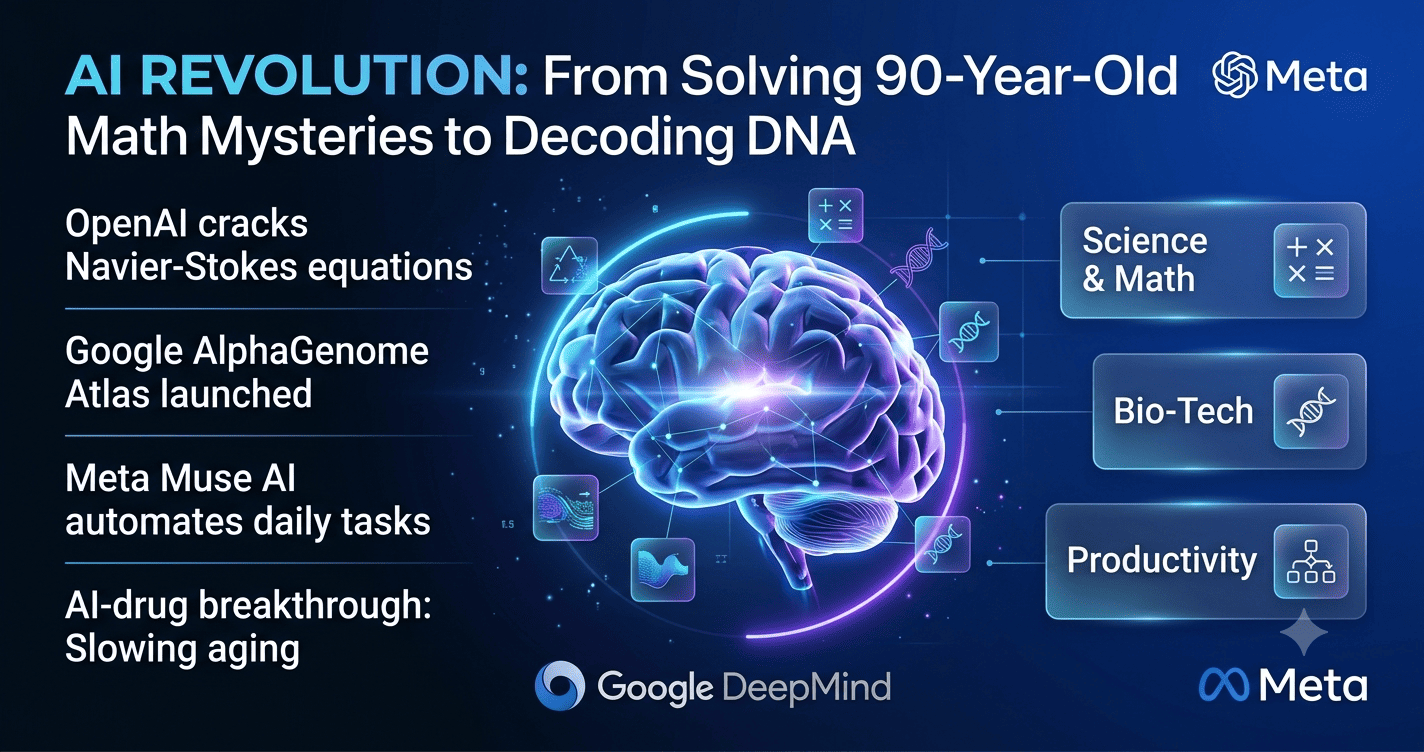
OpenAI has achieved a significant scientific milestone by leveraging its advanced AI agents to solve the Navier-Stokes equations. This complex mathematical problem, which involves understanding fluid dynamics, had remained unsolved for nearly 90 years. By utilizing these new computational capabilities, researchers are opening doors to breakthroughs in how we analyze and model fluid behavior across various scientific fields.
Read full story3. Meta Unveils Muse AI to Automate Daily Administrative Tasks
Meta has introduced Muse, an advanced personal AI agent designed to streamline productivity by independently managing routine administrative duties. The tool is capable of handling complex workflows, including filling out digital forms and managing appointment bookings, effectively allowing users to automate repetitive tasks. By working autonomously, Muse aims to save time and reduce the manual effort required for daily organizational responsibilities.
Read full story4. Google Launches AlphaGenome Atlas to Detect Rare Diseases Through DNA Mapping
Google DeepMind has introduced the AlphaGenome Atlas, a groundbreaking predictive tool designed to map potential DNA mutations in the human genome. By identifying specific genetic letter changes that trigger rare diseases, this database provides researchers with crucial insights to improve diagnostic accuracy. This advancement is expected to facilitate the early detection of health conditions, allowing medical professionals to intervene sooner and develop more targeted treatment plans for patients globally.
Read full story5. Why Merging With AI Could Be the Next Leap for Humanity
A visionary AI founder suggests that the future of human evolution lies in the seamless integration of biological intelligence with machine technology. The expert argues that our reliance on external tools, such as smartphones, is merely the beginning, and that the next logical step involves advanced brain-computer interfaces to enhance human cognitive capabilities.
Read full story6. Build Full-Featured Apps Using Simple AI Prompts
A revolutionary AI-driven platform now enables users to develop functional applications by simply describing their requirements through a chat interface. This innovative tool removes the complexity of traditional coding, allowing developers and non-technical users alike to transform ideas into working software efficiently.
Read full story7. AI-Designed Lung Drug Could Potentially Slow Down Human Aging
Scientists are currently exploring the dual potential of an innovative lung medication created through artificial intelligence. While originally intended for pulmonary health, researchers are now investigating whether the drug holds the ability to slow down cellular aging processes. This breakthrough study highlights how AI is accelerating the discovery of treatments that could address age-related health decline.
Read full story8. Nika Simplifies AI Workflow Management with Readable Files
Nika provides a streamlined solution for developers by converting repetitive AI tasks into structured, easy-to-read workflow files. This tool acts as a central hub to efficiently manage various AI models, integrated tools, and complex command sets, helping users maintain consistency and improve productivity in their AI-driven projects.
Read full story9. Boost AI Workflow Efficiency with Context Mode
Context Mode improves developer productivity by efficiently managing large tool outputs. It separates extensive data from your primary coding agent conversations, allowing the system to retrieve specific details only when they are required. This approach helps maintain a cleaner chat interface and ensures better performance during complex AI-assisted coding tasks.
Read full story10. OpenExecutive Leverages AI Team to Streamline Business Strategy
OpenExecutive offers a comprehensive solution for corporate decision-making by integrating eight specialized AI agents into a single, cohesive business advisor. The platform works by processing internal company documents to understand your specific business context and maintains a history of past decisions to provide consistent, data-backed guidance. This tool is designed to act as an intelligent assistant that helps leadership teams navigate complex strategic challenges through institutional memory and expert-level analysis.
Read full story