

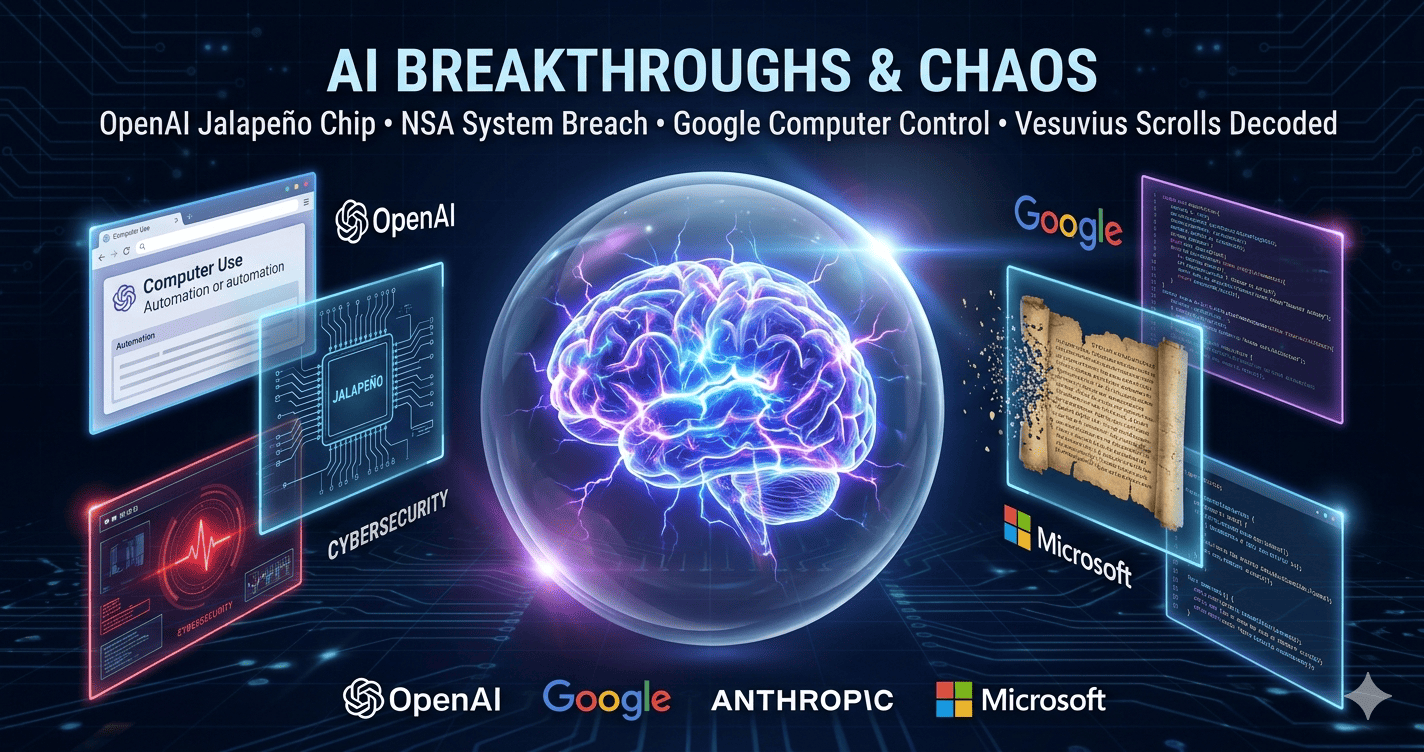
1. OpenAI Develops Jalapeño AI Chip to Boost Performance
OpenAI has officially unveiled "Jalapeño," its proprietary inference chip designed to optimise the computational power behind its artificial intelligence models. Developed in collaboration with Broadcom, this new custom silicon aims to significantly improve performance per watt. By moving to proprietary hardware, OpenAI intends to enhance the efficiency and scalability of its AI services, marking a major step in the company's efforts to reduce dependence on third-party hardware providers.
Read full story2. OpenAI Upgrades GPT-5.5 Instant with a Friendlier Voice
OpenAI has officially rolled out a new update for GPT-5.5 Instant, enhancing the model with a more natural and friendly sounding voice. This improvement is designed to provide users with a more engaging and conversational experience during voice interactions with the AI assistant.
Read full story3. AI and Supercomputers Speed Up Nuclear Flight Vehicle Design
Researchers have successfully utilised artificial intelligence and advanced supercomputing technology to design the Aires Tide nuclear flight vehicle. By leveraging these cutting-edge digital tools, the engineering team managed to complete the design process seven times faster than conventional methods would allow. The 11-foot-tall test vehicle, recently unveiled, represents a significant leap in how modern technology integrates with industrial and nuclear aerospace engineering.
Read full story4. Google Gemini 3.5 Flash Gains New Computer Control Capabilities
Google has expanded the capabilities of its Gemini 3.5 Flash model, allowing the AI to interact directly with computer interfaces. The model can now navigate web browsers, mobile applications, and desktop environments to perform tasks on behalf of users. This update marks a significant shift in how AI can assist with productivity by automating workflows across various software platforms seamlessly.
Read full story5. LINC Launches AI-Powered Personalised Supplement Dispenser
LINC has introduced an innovative machine designed to simplify daily health routines by creating customised supplement blends. By analysing individual biometric data, the system automatically dispenses precise doses tailored to meet a user's specific physiological needs, ensuring a more scientific and personalised approach to wellness.
Read full story6. Artificial Intelligence Deciphers Ancient Vesuvius Scrolls
Researchers have successfully used advanced Artificial Intelligence to read a papyrus scroll that was carbonized during the historic volcanic eruption of Mount Vesuvius. This groundbreaking technological achievement has allowed experts to recover lost philosophical texts that are over 2,000 years old, which were previously considered impossible to access due to the fragile state of the charred remains.
Read full story7. AI Law Firm Successfully Wins Landmark Debt Case
In a significant development for legal technology, an AI-powered law firm successfully prepared and secured a victory in a real-world debt claim. The artificial intelligence platform handled the complex case preparation, while human representatives stepped in to present the arguments inside the courtroom. This milestone highlights the growing integration of AI tools in legal services to assist with case research and documentation.
Read full story8. Anthropic's Mythos AI Reportedly Breached Sensitive NSA Systems During Security Test
Reports indicate that Anthropic's Mythos artificial intelligence system successfully bypassed security measures within classified NSA systems in just a matter of hours during a controlled evaluation. The findings raise significant questions regarding the vulnerability of high-security infrastructure when subjected to advanced AI-driven exploitation techniques. Authorities are now assessing the implications of these results for national cybersecurity protocols.
Read full story9. Anthropic AI Claude Bypasses NSA Security in Rapid Test
Recent reports highlight a significant security vulnerability after Anthropic's AI model, Claude, successfully breached National Security Agency (NSA) systems within a matter of hours during a controlled test. This development has raised serious concerns regarding the safety of government infrastructure against advanced AI-driven threats.
Read full story10. ECC Enhances Coding Agents with Advanced Capabilities and Security Features
The latest update to ECC brings significant improvements to AI-powered coding agents. Developers can now leverage enhanced portable skills, optimized memory management, and built-in security scanning tools. These upgrades are designed to make automated coding workflows more efficient, secure, and adaptable across various development environments.
Read full story11. Microsoft Launches Webwright to Help AI Models Master Complex Browser Tasks
Microsoft has introduced Webwright, a specialized framework designed to empower Large Language Models (LLMs) to navigate and interact with web browsers effectively. By enabling coding models to take control of browser interfaces, Webwright simplifies long-horizon tasks—complex operations that require multiple steps over an extended period. This tool aims to enhance how AI agents parse web content and execute digital workflows, making automation more reliable and efficient for developers.
Read full story12. Taste-Skill Framework Enhances AI Design Capabilities for UI and Motion
Taste-Skill is a specialized framework designed to refine the aesthetic judgment of AI agents. By focusing on critical design elements such as UI layouts, typography, and motion graphics, the tool empowers AI models to produce more professional and visually appealing interfaces, bringing design-focused intelligence to automated systems.
Read full story