
1. OpenAI Introduces New GPT-5.6 Sol Model for Development Partners
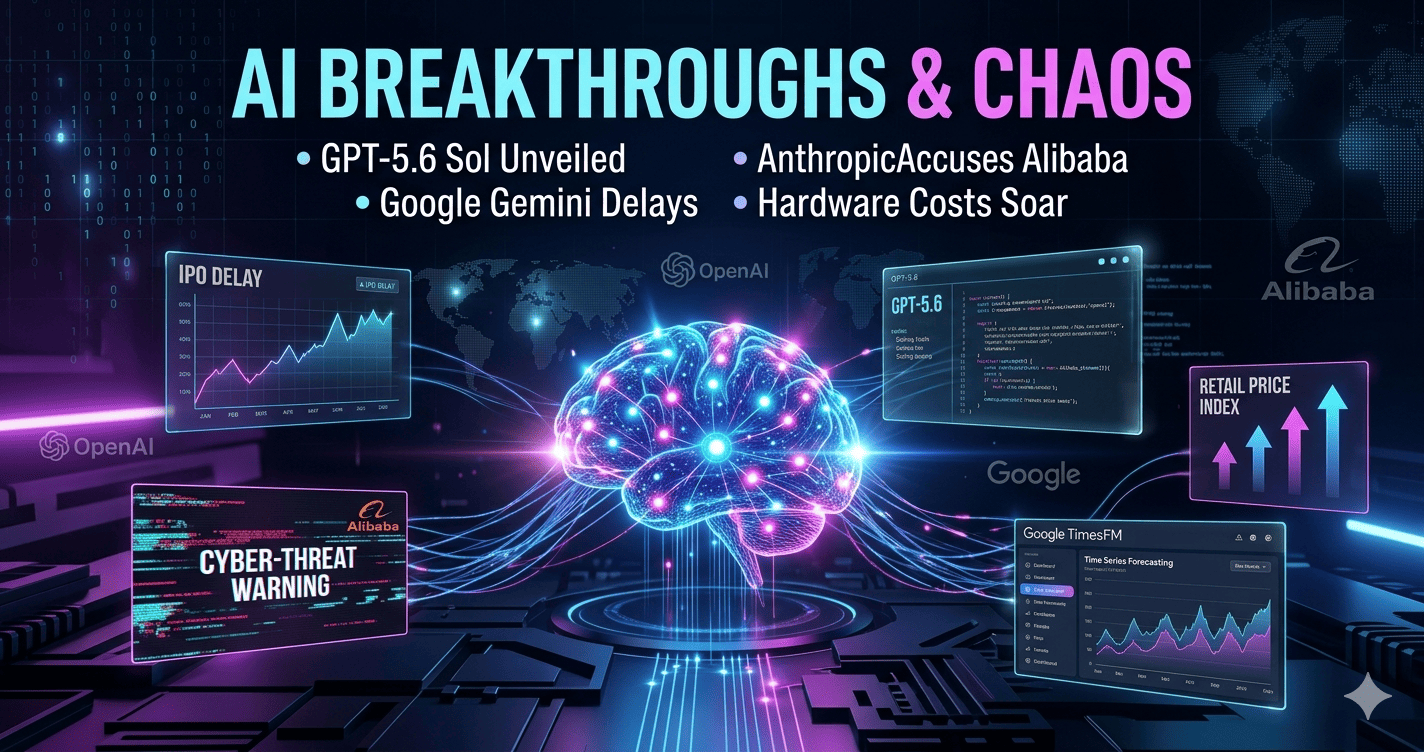
OpenAI has officially unveiled its latest language model, GPT-5.6 Sol, which is now accessible to select development partners. This new iteration includes a specialized "Ultra" mode designed to enhance performance and capabilities for specific enterprise applications. While not yet available for the general public, this preview release allows partners to integrate and test the advanced features of the Sol architecture.
Read full story2. OpenAI Plans to Postpone IPO Until 2027
Reports suggest that OpenAI is likely to delay its much-anticipated initial public offering (IPO) until 2027. This decision follows a period of market instability and comes in the wake of the lukewarm public stock debut of SpaceX. The company is currently evaluating its strategic roadmap to ensure a more successful market entry in the future.
Read full story3. Anthropic Accuses Alibaba of Stealing AI Model Capabilities
AI safety firm Anthropic has leveled serious allegations against Alibaba’s Qwen laboratory, claiming the latter orchestrated a coordinated effort to extract data from its Claude AI model. According to the complaint, the Qwen team reportedly deployed over 25,000 automated accounts to scrape and siphon valuable technical information from Claude. Anthropic asserts that this move was a deliberate attempt to gain proprietary intelligence and steal the core capabilities of its advanced language model.
Read full story4. Google Reschedules Gemini 3.5 Pro Launch to July
Google has officially delayed the release of its highly anticipated Gemini 3.5 Pro model until July. The tech giant is postponing the launch to focus on enhancing the model's capabilities, specifically targeting improvements for autonomous AI agents and complex, long-horizon tasks. This extra time will allow developers to refine the model's token management and overall performance for more sophisticated real-world applications.
Read full story5. AI Delegation Boosts Job Security for Employees
Recent research suggests that employees who actively delegate tasks to artificial intelligence tend to feel more confident and secure in their professional roles. By leveraging AI to handle repetitive or complex workloads, workers are reporting a positive shift in their productivity and overall job stability, suggesting that integrating automation can actually reinforce human value in the workplace rather than diminish it.
Read full story6. AI Growth Leads to Rising Hardware Costs for Apple and Xbox Users
Major tech companies, including Apple and Microsoft (Xbox), are raising prices for their hardware devices. This price hike is primarily driven by the surging global demand for memory chips, which are being heavily consumed by data centers to power advanced artificial intelligence infrastructure. Consequently, the reduced supply of these essential components for consumer electronics is directly impacting the costs passed on to customers.
Read full story7. Why Tricking AI Resume Screeners With Hidden Text No Longer Works
Job seekers often use hidden text within their resumes to bypass AI-powered Application Tracking Systems (ATS) and secure interviews. However, new research indicates that this tactic is increasingly ineffective. As more candidates adopt these "resume hacks," AI screening software is evolving to detect and penalize such manipulation. Ultimately, the overuse of these hidden techniques serves as a self-defeating strategy that compromises a candidate's credibility and chances of landing a job.
Read full story8. Planable Integrates Claude AI to Boost Project Workflow Efficiency
Planning and collaboration platform Planable has announced a new integration with the AI model Claude. This update is designed to help marketing teams and project managers streamline their workflows by automatically identifying missing information and pinpointing tasks that have become stalled across various client projects. By leveraging Claude’s advanced analytical capabilities, users can now maintain better oversight of their content pipelines and ensure timely project completion.
Read full story9. Google Launches TimesFM for Advanced Time Series Forecasting
Google has introduced TimesFM, a powerful foundation model specifically designed for time series forecasting. This versatile tool comes pre-trained on a vast range of data, enabling users to perform accurate forecasting tasks without the need for additional training or fine-tuning. By leveraging this model, developers and data scientists can effectively predict future trends with greater efficiency and ease.
Read full story10. Visualize AI Agent Outputs with Visual-Explainer
Visual-Explainer is a powerful tool designed to convert raw terminal output from AI agents into clean, professional HTML pages. By transforming complex text-based logs into easy-to-read reports and structured diagrams, it helps developers better track, analyze, and present the decision-making processes of their AI agents.
Read full story11. Optimize Codebase Queries with codebase-memory-mcp
The codebase-memory-mcp tool enhances development workflows by indexing entire software repositories into a structured knowledge graph. This efficient indexing allows developers to retrieve accurate answers to complex queries rapidly while significantly reducing token consumption during interactions with AI models.
Read full story