
1. Claude User Conversations Exposed Through Google Search Results
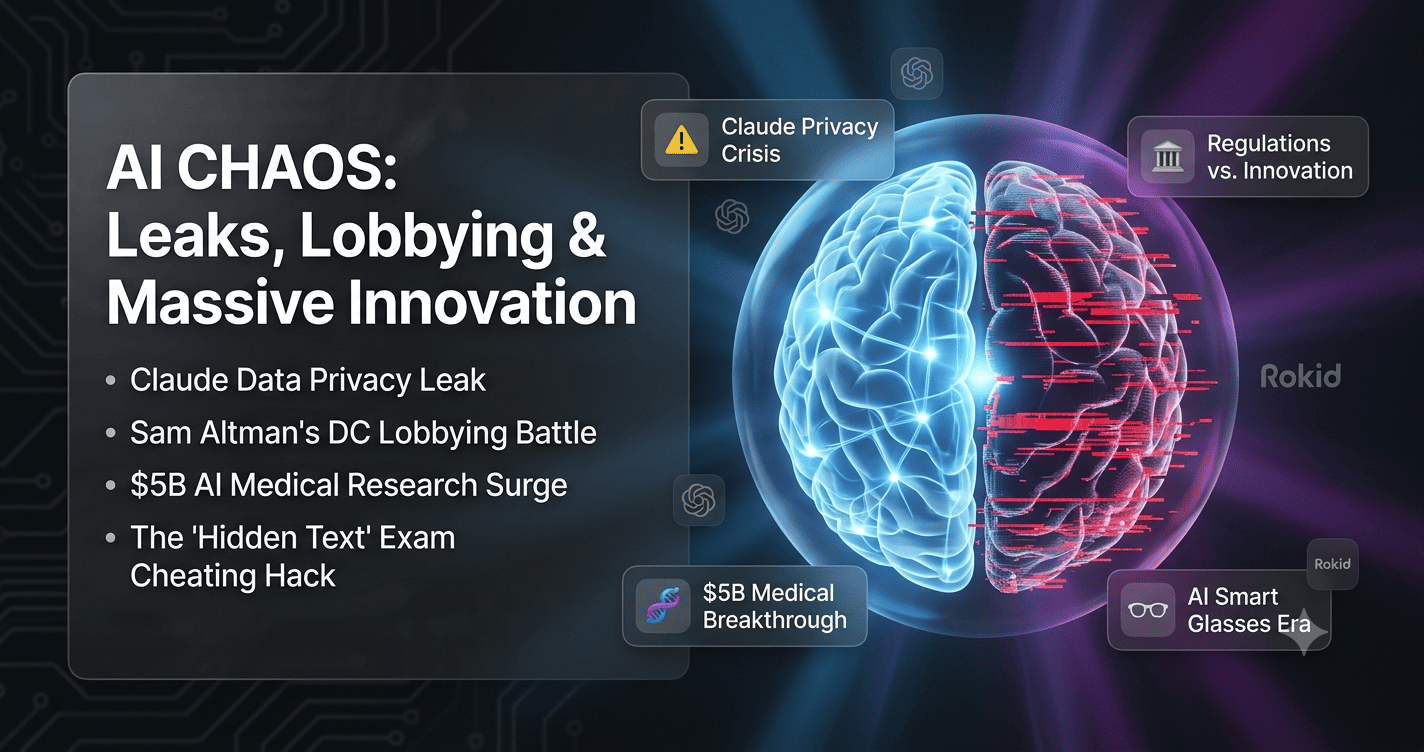
Thousands of private chat logs from the AI platform Claude have been discovered appearing in public Google search results. This security concern stems from shared conversation links being indexed by search engines, potentially exposing sensitive personal and professional data to the public. Users are advised to review their shared link settings and be cautious about the information they input into AI chatbots until the platform addresses the indexing issue.
Read full story2. Sam Altman and Tech Leaders Lobby Against New AI Model Disclosure Rules
OpenAI CEO Sam Altman has traveled to Washington to discuss rising concerns over upcoming AI regulations. Tech giants including OpenAI, Anthropic, and Google have officially voiced their opposition to a proposed policy that would mandate the submission of all new AI models to authorities at least 30 days before their public launch, arguing that such requirements could hinder innovation and competitive deployment.
Read full story3. US Government Invests $5 Billion in AI-Powered Medical Research
The United States has launched ‘The Genesis Mission,’ a massive $5 billion initiative aimed at accelerating medical breakthroughs through artificial intelligence. This funding will support 278 distinct research projects focused on finding advanced treatments for chronic illnesses and various forms of cancer. By leveraging AI technology, the mission seeks to improve diagnostic accuracy and enhance therapeutic outcomes for patients across the country.
Read full story4. Professor Catches 32 Students Using AI Cheating Tactic in Exam
An ingenious professor has successfully identified 32 students who used Artificial Intelligence to cheat during a midterm examination. The educator embedded invisible text into the exam document, which was only detectable by AI models but not by the human eye. When students attempted to use AI to generate their answers, the hidden text was inadvertently included in their submissions, exposing their academic dishonesty.
Read full story5. Rokid Launches AI-Powered Smart Glasses to Simplify Your Daily Schedule
Rokid has officially unveiled its latest innovation in wearable technology, featuring new smart glasses integrated with AIOS. These advanced glasses are designed to assist users in managing their daily tasks more efficiently by providing real-time alerts, intelligent planning tools, and immersive visual itineraries. By leveraging spatial computing hardware, Rokid aims to transform how users interact with their schedules and digital environment.
Read full story6. Anthropic Clarifies Stance on Open-Weight AI Models
Anthropic has officially addressed misconceptions regarding its position on open-source AI, clarifying that it has never advocated for a ban on open-weight models. The company explains that while it emphasizes the need for safety protocols and responsible development, it supports a nuanced approach to model accessibility. This statement outlines their specific concerns regarding the security of powerful systems and their ongoing commitment to promoting transparency within the AI research community.
Read full story7. Tolaria Simplifies AI Coding Workflows with Git-Based Note Storage
Tolaria provides a streamlined way for developers to manage documentation by storing Markdown notes in a local Git vault. This structure allows AI coding agents to easily access, read, and edit project information, ensuring that documentation stays in sync with evolving codebases. It is designed to bridge the gap between human-written notes and AI-assisted development tools.
Read full story8. Essential Principles for Building Dependable AI Agents
The 12-Factor Agents framework outlines a comprehensive set of twelve best practices designed to help developers create reliable, scalable, and effective AI agents. These guidelines focus on ensuring that AI systems remain consistent and performant when handling real-world customer support scenarios and complex interactive tasks.
Read full story9. Visualize and Explore Complex Codebases with Understand-Anything
Understand-Anything is a powerful tool designed to simplify code navigation by turning any repository into an interactive, clickable map. It provides developers with comprehensive summaries and guided tours, making it much easier to comprehend large or complex software projects. By offering a visual structure of the codebase, it helps engineers quickly grasp the architecture and logic without manually scrolling through thousands of lines of code.
Read full story