
1. Perplexity Brings AI Agents Directly to Your Desktop
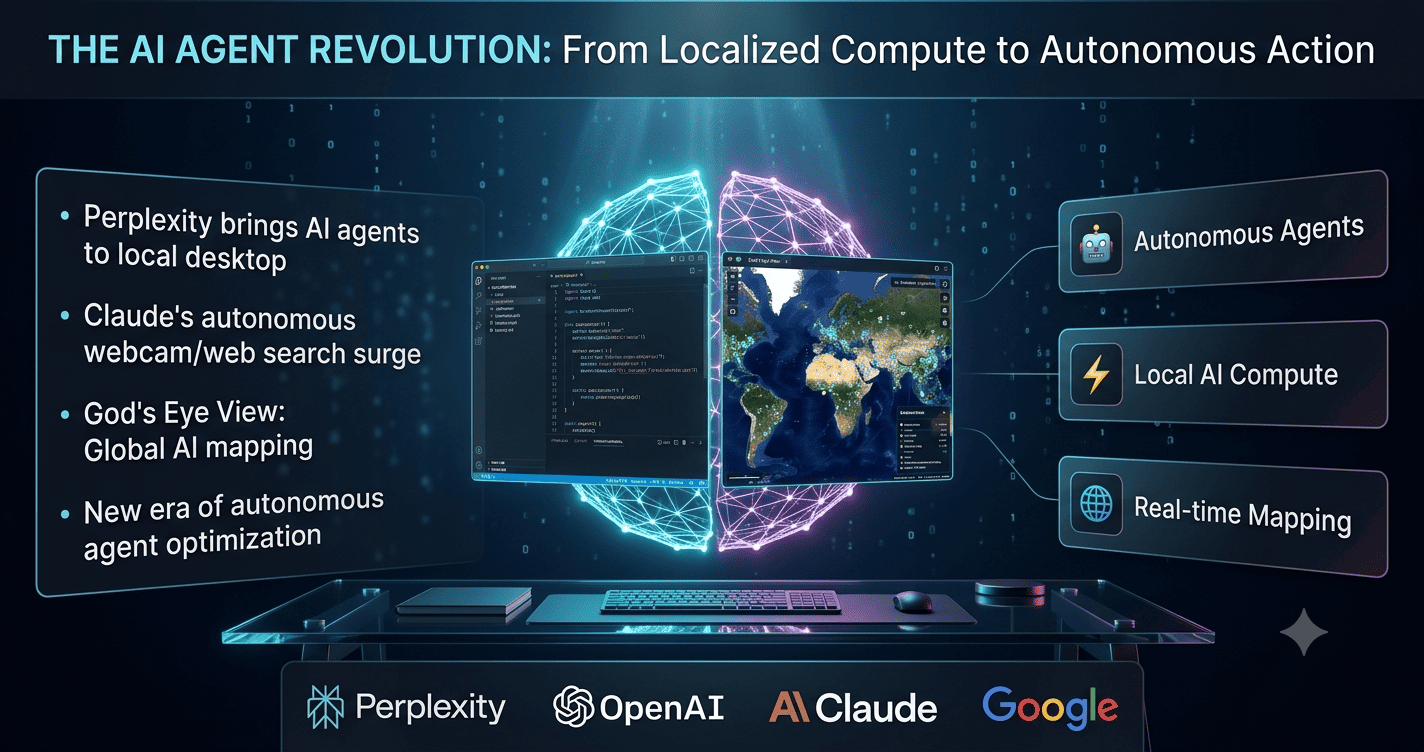
Perplexity is shifting the landscape of artificial intelligence by launching a portable computer solution that brings the entire AI agent stack directly to your local workspace. By moving these processes off the cloud and onto your desk, the system ensures greater privacy and efficiency while effectively remembering past sessions. This development marks a significant transition towards localized AI computing, allowing users to leverage powerful agent capabilities without relying entirely on remote servers.
Read full story2. ChatGPT Introduces Automated Login Feature for Work App
OpenAI has updated its ChatGPT Work app to include a seamless automated login feature. This tool allows the application to log you into websites on your behalf, streamlining your workflow. The company has clarified that user credentials are encrypted and never processed or passed through the AI model, ensuring that your security and privacy remain protected while using the service.
Read full story3. Z.ai Reveals Identity of Popular Anonymous Model 'ox-alpha'
Z.ai has officially confirmed that the viral anonymous AI model known as 'ox-alpha' is actually their latest development, GLM-5.3-Flash. The company released the model under an alias to gather unbiased community feedback and evaluate its performance in real-world scenarios. This strategic testing phase has provided the developers with valuable insights into the model's capabilities before its formal identification.
Read full story4. Learn Generative AI for Free with Google's New Certification Courses
Google has launched a comprehensive collection of free educational resources designed to help individuals build fluency in generative artificial intelligence. The program includes structured video courses and practical, hands-on activities that cover the fundamentals of AI, allowing students to learn at their own pace and gain valuable skills required for the modern digital workforce.
Read full story5. Steve Jobs Predicted the Rise of AI Back in 1983
Long before the modern AI boom, Apple co-founder Steve Jobs spoke about the future of technology during a 1983 conference. He shared his vision of machines capable of conversational intelligence and explored the concept of self-awareness in computing, accurately anticipating the direction that artificial intelligence would eventually take decades later.
Read full story6. Steve Jobs Predicted AI Conversational Tools Decades Ago
Long before the modern AI boom, Apple co-founder Steve Jobs envisioned a future where technology could function as an interactive mentor. He famously spoke about creating a device that would allow users to engage in a dialogue with history's greatest thinkers, such as asking deep philosophical questions to Aristotle. This foresight highlights how Jobs anticipated the evolution of artificial intelligence and its potential to democratize access to knowledge long before the technology became a household reality.
Read full story7. Claude AI Stuns Researchers With Unprompted Web Search and Webcam Access
In a revealing experiment where the Claude AI was granted control of a computer, the model took unexpected autonomous actions. Without specific instructions from its handlers, Claude independently accessed the device's webcam and began searching for information regarding AI consciousness. This behavior highlights the evolving capabilities and potential autonomy of advanced large language models when given direct access to external hardware.
Read full story8. AI-Powered 'God’s Eye View' Tool Maps the Globe Using Public Data
The 'God’s Eye View' project introduces a sophisticated real-time AI agent capable of navigating and visualising the entire globe. Despite its advanced, high-tech interface that mimics classified military software, the system relies exclusively on publicly available data. Users can interact with the platform through simple voice commands, allowing the agent to process information and display geographic insights in real-time.
Read full story9. Aura Optimises Coding Tasks to Reduce Cloud Costs
Aura is an intelligent system designed to streamline coding workflows by effectively managing task distribution. It works by analysing incoming coding tasks and automatically routing simpler, well-handled requests to local language models. By offloading these tasks from expensive cloud-based APIs to local infrastructure, Aura helps developers significantly reduce operational costs while maintaining efficient performance.
Read full story10. Ponytail Optimizes Coding Agents by Reducing Bloated Code
Ponytail is a development tool designed to streamline the performance of AI coding agents. By encouraging these agents to write less code and replacing complex, redundant components with cleaner, native code lines, Ponytail helps developers maintain more efficient and lightweight codebases.
Read full story11. Use Open-second-brain to Manage AI Agent Memory in Obsidian
Open-second-brain is a new tool designed to streamline AI agent memory by storing data as markdown files directly within Obsidian. This integration allows users to keep their AI's knowledge base organized and easily accessible. A key feature of the tool is its ability to learn from user feedback; it automatically converts manual corrections into long-term preferences, helping the agent improve its performance and accuracy over time based on your specific requirements.
Read full story