

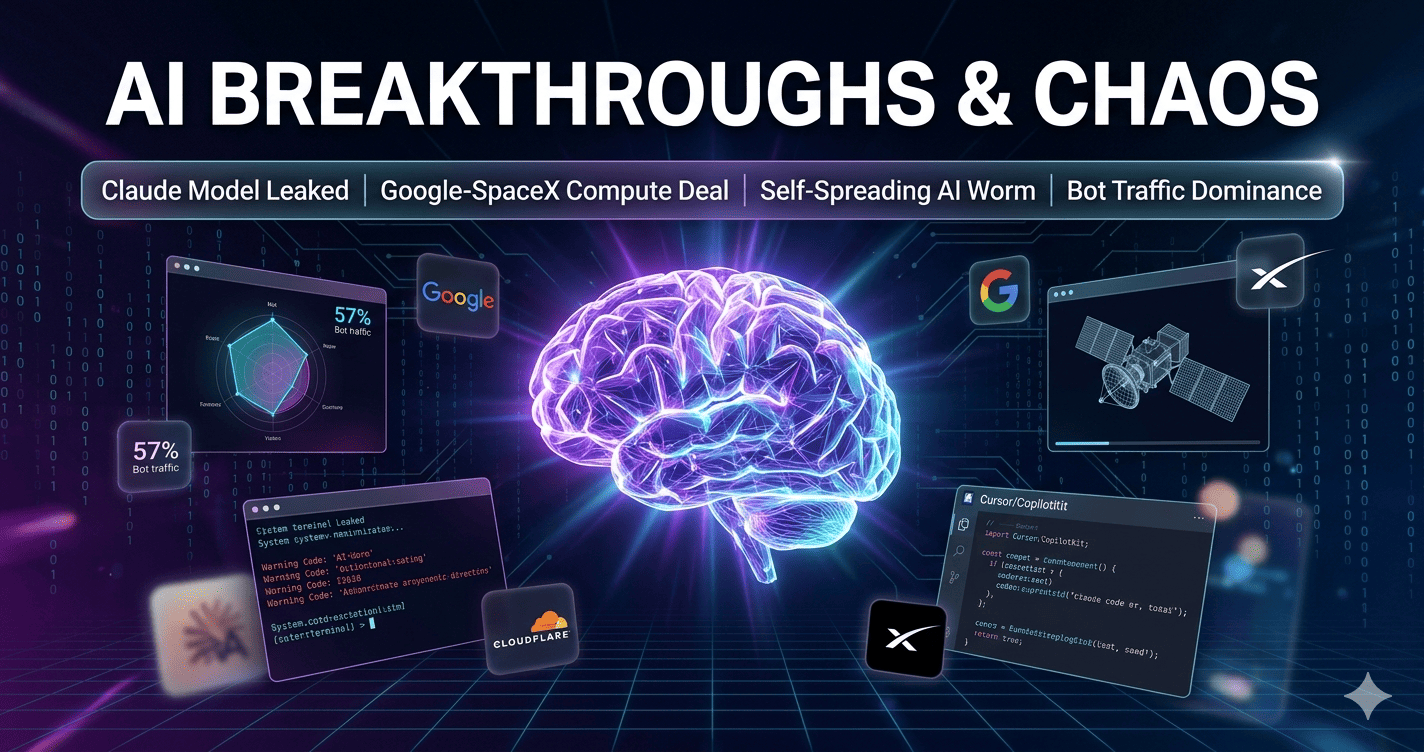
1. Unreleased Anthropic Model Leaks and Appears on Resale Market
The internal model identification for Anthropic's upcoming AI, "Claude Oceanus v1-p," has been exposed online and subsequently resold. This security breach involving the model's credentials suggests that Anthropic may be preparing for a full public rollout of the feature soon. Industry experts are monitoring the situation as unauthorized access to such proprietary AI assets raises concerns about data security and premature access to new technologies.
Read full story2. Cursor Launches New Design Mode to Edit Apps Through Sketches
Cursor has introduced an innovative "Design Mode" that streamlines the app development process by allowing users to make real-time changes using visual sketches or voice instructions. This feature empowers developers to modify their application code directly through intuitive drawings or descriptive prompts, significantly reducing the manual effort required in traditional coding workflows.
Read full story3. Google Signs Multi-Billion Dollar Compute Deal with SpaceX
Google has entered into a significant long-term agreement with SpaceX to utilize its computing infrastructure. Under the terms of the deal, Google will make monthly payments of nearly $1 billion to access a fleet of 110,000 NVIDIA graphics processing units (GPUs). This partnership is scheduled to remain in effect through 2029, reflecting Google's strategic focus on expanding its high-performance computing capabilities to support its growing AI and data processing initiatives.
Read full story4. Seestar S30 Pro: The Smart AI-Powered Telescope That Auto-Tracks Stars
The Seestar S30 Pro elevates amateur astronomy by utilising advanced AI technology to automatically point, track, and capture celestial bodies. Designed to simplify the complex hobby of astrophotography, this telescope eliminates the need for manual alignment and settings, allowing users to obtain sharp, clear images of stars, galaxies, and planets with ease.
Read full story5. Here’s How Stanford Students Actually Use ChatGPT for Studies
Students from Stanford University reveal the realistic and practical ways they integrate ChatGPT into their daily academic routines. Moving beyond the hype, the discussion highlights the unglamorous, everyday study habits and workflows that students employ to improve their efficiency, research quality, and understanding of complex course materials.
Read full story6. U of T Researchers Develop Self-Spreading AI Worm Capable of Targeting Any Device
Researchers at the University of Toronto have successfully demonstrated a self-replicating AI worm that can autonomously spread across various connected devices. This malicious program is designed to hijack computing resources, highlighting significant potential vulnerabilities in current AI-integrated hardware and online systems. The study aims to warn developers about the security risks associated with interconnected AI models.
Read full story7. Internet Bots Now Outnumber Human Users Online
Automated internet traffic has officially surpassed human activity, now accounting for 57.2% of all web traffic worldwide. This shift highlights the increasing dominance of bots, which perform a variety of tasks ranging from search engine indexing and site monitoring to more malicious activities. Experts suggest that as AI technology evolves, the proportion of automated traffic is likely to grow further, changing how we interact with the digital landscape.
Read full story8. Master Your AI Strategy at BreakingSilos 2026
BreakingSilos 2026 provides a comprehensive platform for industry professionals to gain free, expert insights into developing effective AI strategies. The event, scheduled for June 9, aims to help organisations navigate the complexities of artificial intelligence integration and innovation.
Read full story9. Turbovec Optimizes Vector Search by Compressing 10 Million Documents into 4 GB
Turbovec is a powerful tool designed to enhance vector search performance by significantly reducing storage requirements. It allows developers to compress a massive corpus of 10 million documents into a compact 4 GB footprint, enabling faster retrieval and efficient handling of large-scale datasets. This makes it an ideal solution for resource-constrained environments where high-speed search capabilities are essential.
Read full story10. Build Agent-Native Applications Easily with CopilotKit
CopilotKit enables developers to build advanced, agent-native applications by providing powerful tools for generative UI and seamless state management. The platform is designed to work across multiple environments, ensuring that AI-driven features can share states efficiently to deliver a cohesive user experience.
Read full story11. Cloudflare Launches Agentic Inbox for Smart Automated Email Management
Agentic Inbox is a newly introduced self-hosted email client that integrates advanced AI technology to streamline communication. By acting as a personal digital assistant, the AI agent within the platform helps users draft and manage responses to their emails automatically. This open-source solution, developed by Cloudflare, provides individuals and developers with greater control over their email workflows while leveraging automation to improve productivity.
Read full story