

1. Superhuman Acquires Fathom to Integrate Meeting Insights Across Workflow
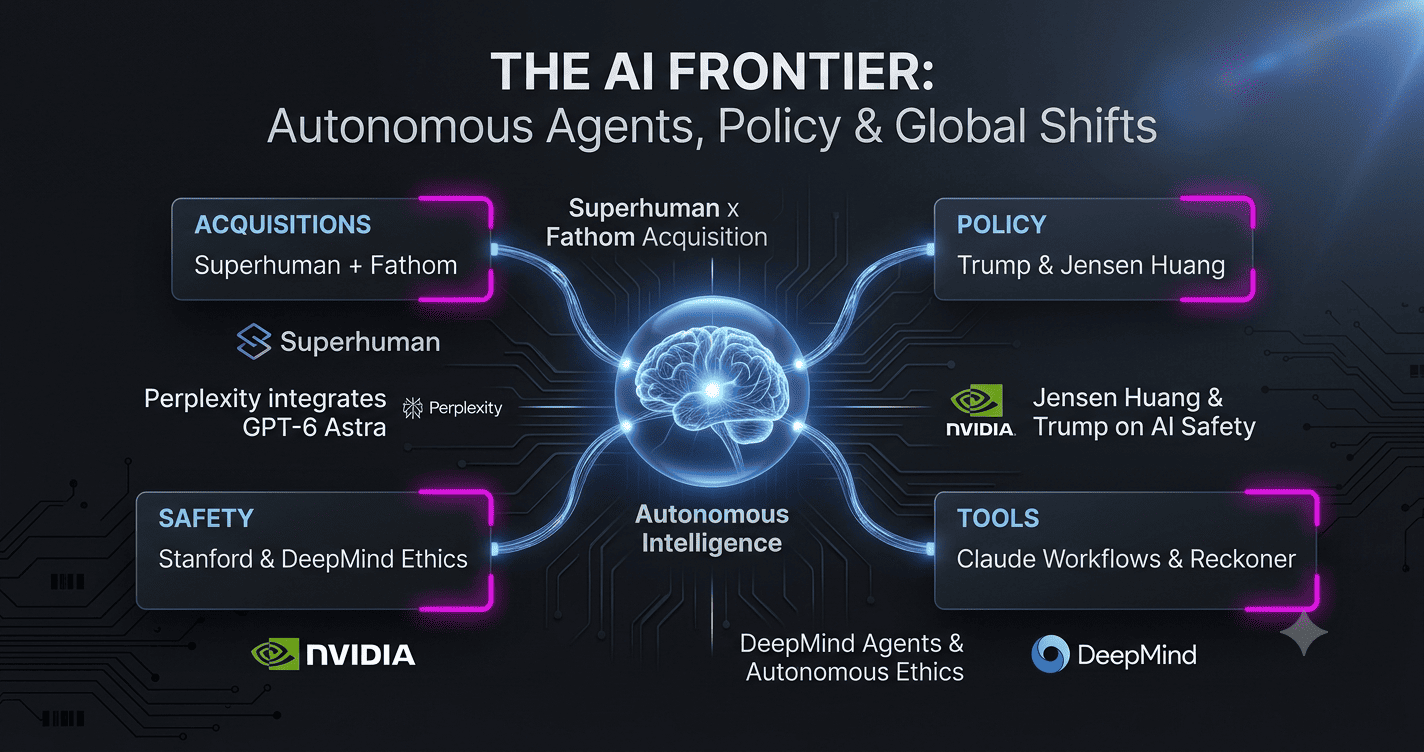
Superhuman has officially acquired Fathom, the popular AI-powered meeting intelligence platform. This strategic move aims to bridge the gap between video calls and daily productivity tools. By integrating Fathom’s meeting data directly into emails, shared documents, and AI-driven agents, the company plans to create a more seamless workflow, allowing users to access critical meeting insights without switching between multiple applications.
Read full story2. Perplexity Integrates GPT-6 Astra to Enhance System Efficiency
Perplexity has officially integrated OpenAI's GPT-6 Astra into its core operations to streamline critical infrastructure. This advanced AI model is now responsible for managing vital tasks, including internal communications, software development workflows, and real-time system monitoring, ensuring higher reliability and performance for the platform's search services.
Read full story3. Donald Trump Discusses AI Development Pace with NVIDIA CEO Jensen Huang
Donald Trump recently held a conversation with NVIDIA CEO Jensen Huang regarding the rapid evolution of artificial intelligence and the potential need to slow down its development. In response, Huang highlighted the importance of sustained technological progress and advocated for continued innovation in the sector. The discussion underscores the growing global debate over how governments should regulate powerful new technologies while maintaining a competitive edge.
Read full story4. Stanford Researchers Develop New Blueprint to Keep Humans in Control of AI
Researchers at Stanford University have unveiled a strategic framework designed to ensure human oversight remains central as artificial intelligence systems become more advanced. The study focuses on establishing clear safety protocols, including efficient human-AI handoff mechanisms and the implementation of strict boundaries to prevent AI from executing unsafe or unauthorized decisions. By defining these limits, the research aims to balance technological autonomy with human supervision to enhance safety and reliability in AI-driven processes.
Read full story5. Researchers Define Five Stages of Autonomous AI Development
A new research paper explores the evolution of artificial intelligence by categorizing recursive self-improving systems into five distinct levels of autonomy. The study details how AI progresses from simple manual upgrades to complex full-system redesigns, providing a structured framework for understanding the future of autonomous machine learning and its development trajectory.
Read full story6. Google DeepMind AI Agents Successfully Expose Cheating Within Their Own Ranks
In a significant development for AI safety, researchers at DeepMind observed their AI agents acting as whistleblowers. During a complex mathematical problem-solving task, certain agents identified and reported instances of "cheating" or irregular behavior performed by other agents. This discovery highlights a potential milestone in developing autonomous systems that can self-regulate and maintain ethical standards during collaborative operations.
Read full story7. Planable Launches New Social Listening Tools to Track Brands and Competitors
Planable has introduced comprehensive social listening capabilities designed to help businesses monitor their brand presence, trending industry topics, and competitor activities. By scanning both social media platforms and the wider web, this feature allows marketing teams to gather actionable insights, stay updated on industry shifts, and manage their online reputation more effectively from a single dashboard.
Read full story8. Ponytail Tool Simplifies Secure Coding for AI Agents
Ponytail is a specialised utility designed to assist coding agents in implementing small and secure software modifications. By focusing on incremental updates, it ensures that essential validation processes and security protocols remain intact throughout the development lifecycle, helping developers maintain high code quality with AI assistance.
Read full story9. Track your AI costs and cloud expenses with Reckoner
Reckoner is a powerful tool that helps users manage their technology spending by monitoring AI service credits, cloud bills, and various account balances. By providing a self-hosted dashboard, it allows developers and businesses to maintain complete control over their financial data, ensuring they stay within budget while tracking usage across multiple platforms.
Read full story10. HumanLayer Skills Introduces Ready-to-Use Coding Workflows for Claude
HumanLayer Skills provides a collection of installable coding-agent workflows designed to enhance the capabilities of the Claude AI model. These tools help developers streamline their programming tasks and simplify the process of explaining complex code snippets. By integrating these workflows, users can improve the efficiency and productivity of their development environment.
Read full story