

1. Codex Automates Tasks by Observing Your Screen Activity
OpenAI's Codex now features advanced capabilities that record your screen actions to generate reusable skills. By observing how users perform specific workflows, the system learns to replicate those steps, effectively simplifying complex task automation. This development aims to assist users in streamlining repetitive digital tasks by turning observed manual actions into automated processes.
Read full story2. Amazon Scraps Plans for OpenAI Biopic 'Artificial'
Amazon's MGM studio has officially decided to move away from 'Artificial', a high-profile biographical film centered on the dramatic firing and subsequent reinstatement of OpenAI CEO Sam Altman. The movie, which was set to star Andrew Garfield, is now being shopped to other studios as Amazon opts out of the production. The project originally aimed to capture the rapid developments within the AI sector, but it will now seek a new home to proceed with its development.
Read full story3. Pinterest Shifts Focus from Keywords to User Taste for Smarter Shopping
Pinterest is upgrading its advertising and user experience through the new 'Ask Pinterest' feature. By evolving shopping into a conversational interface, the platform is moving beyond traditional keyword searches to leverage unique 'taste signals.' This data-driven approach helps advertisers better align products with individual user preferences, making discovery more intuitive and personalised for millions of users worldwide.
Read full story4. New AI-Powered System Uses Water Jets to Drive Pigeons Away
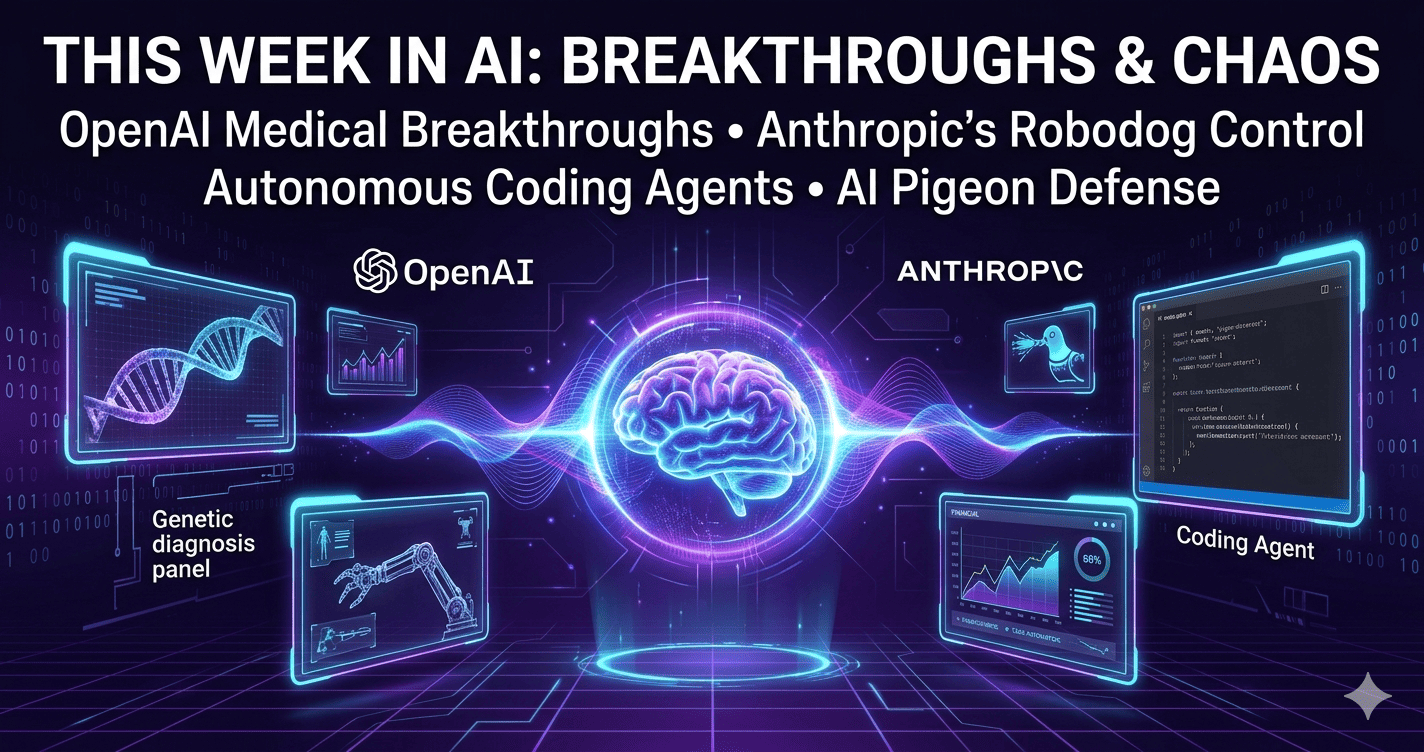
Developers have created an automated pigeon defense system that integrates advanced AI technology with a precision water gun. Designed to protect balconies from nuisance birds, the device identifies incoming pigeons and triggers water jets to deter them. While the technology offers a modern solution to an age-old urban pest problem, it has also sparked a debate regarding the ethical implications of using automated systems against wildlife.
Read full story5. Claude AI Successfully Operates Robodog 20 Times Faster Than Humans
In a groundbreaking research project titled 'Project Fetch', Anthropic’s AI model, Claude, demonstrated its ability to autonomously set up and control a robotic dog. The AI performed these complex tasks 20 times faster than human counterparts, marking a significant milestone in autonomous robotics and artificial intelligence integration. This research highlights the growing capability of large language models to bridge the gap between digital problem-solving and physical world interaction.
Read full story6. OpenAI's AI model identifies 18 rare childhood diseases from genetic data
OpenAI’s advanced o3 reasoning model has successfully diagnosed 18 rare childhood diseases that previously remained unsolved. By re-analysing a collection of 376 genomic sequences that had been labelled as cold cases, the AI was able to identify complex genetic markers. This achievement highlights the potential of artificial intelligence in revolutionising medical diagnostics and providing answers to families seeking clarity on rare health conditions.
Read full story7. Use gpt4free to Integrate Multiple LLM Providers via One API
The gpt4free repository serves as a powerful aggregator that brings together various Large Language Model (LLM) providers under a single, OpenAI-compatible API. This tool simplifies the development process by allowing users to access multiple AI models seamlessly. In addition to the API, it provides a functional local graphical user interface (GUI) and robust client support, making it an efficient solution for developers looking to manage diverse AI resources in one unified platform.
Read full story8. Superlog Launches AI Agents to Automate Production Debugging
Superlog is an innovative tool designed to streamline technical operations by automatically ingesting complex system data. It intelligently groups related incidents to reduce noise and dispatches specialised AI agents to perform autonomous debugging in production environments. This solution helps engineering teams identify and resolve issues faster, minimising downtime and manual intervention.
Read full story9. Boost AI Coding Efficiency With Codebase Memory MCP
Codebase Memory MCP is an innovative tool designed to enhance AI-driven development. It functions by indexing entire code repositories into a structured knowledge graph. This organisation allows AI coding agents to perform rapid and precise structural queries, significantly improving their ability to understand and navigate complex codebases during the development process.
Read full story