

1. OpenAI Launches Smaller, Faster GPT-5.4 Mini and Nano Models
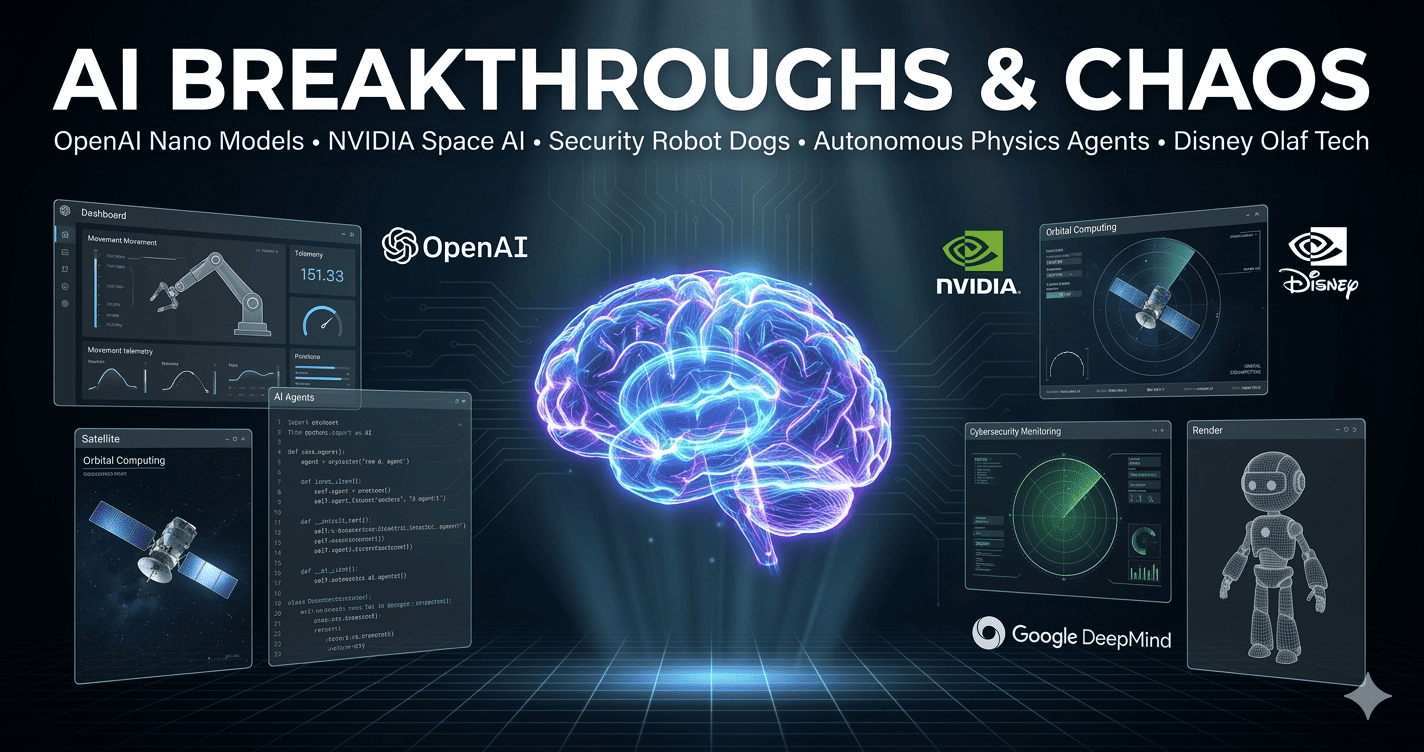
OpenAI has officially introduced its latest artificial intelligence models, GPT-5.4 Mini and GPT-5.4 Nano. These new versions are designed to be quicker and more compact, making them particularly efficient for specialised tasks. Both models are specifically optimised to enhance performance in areas like coding and managing subagent workloads, offering developers and users advanced capabilities for various applications.
Read full story2. NVIDIA Introduces Space-1 Vera Rubin Module, Extends AI to Orbit
NVIDIA recently announced its latest innovation, the Space-1 Vera Rubin Module, at the GTC 2026 conference. This groundbreaking development aims to bring advanced data-center AI capabilities directly into Earth's orbit. The module signifies a major step in space computing, allowing for high-performance artificial intelligence processing in extraterrestrial environments for various scientific and operational applications.
Read full story3. Robot Dogs Now Secure AI Data Centers
Leading robotics companies, Boston Dynamics and Ghost Robotics, have started deploying advanced robot dogs to patrol and secure artificial intelligence (AI) data centers. These quadruped robots are designed to enhance physical security by autonomously monitoring facilities, detecting unauthorized access, and performing surveillance tasks, thereby safeguarding critical data infrastructure.
Read full story4. Palmer Luckey Explains How AI and Autonomous Weapons Bridge US-China Gap
Palmer Luckey, a prominent figure in the tech world known for founding Oculus VR, shares his insights on the evolving landscape of artificial intelligence (AI) and autonomous weapon systems. He elaborates on how these advanced technologies are significantly impacting the strategic military balance, effectively narrowing the technological and operational gap between global superpowers like the United States and China. His discussion delves into the potential implications for future warfare and international relations.
Read full story5. Mo Highlights Social Media's Impact on AI Risks
Mo argues that the primary danger associated with Artificial Intelligence (AI) does not stem from AI itself, but rather from the potential for AI models to adopt values and biases prevalent in negative social media content. This perspective suggests that the information AI learns from, particularly the toxic and biased data found on various social media platforms, could lead to problematic AI behaviours and decisions. The real risk lies in AI systems mirroring or amplifying the negativity they absorb from their training data.
Read full story6. Anthropic Shares Internal Guide on Using Claude Code Skills
Anthropic has released a detailed playbook outlining how their internal engineers effectively utilise Claude's code-related capabilities. This guide provides insights into best practices and strategies for leveraging Claude's coding skills, offering a unique perspective from the developers themselves.
Read full story7. Disney Debuts Free-Walking Olaf Robot at GTC 2026
Disney recently unveiled its innovative free-walking Olaf robot at the GTC 2026 conference. This advanced robot, inspired by the beloved character from "Frozen," received extensive training in virtual environments, allowing it to move autonomously and interact in real-world settings. Its debut marks a significant step in robotics and artificial intelligence development for entertainment purposes.
Read full story8. Disney Imagineering Develops Advanced Olaf Robot with NVIDIA and Google DeepMind
Disney Imagineering has successfully created an advanced Olaf robot, integrating cutting-edge technology from leading brands. This innovative robot was developed using NVIDIA's sophisticated simulation stack for realistic movements and Google DeepMind's Newton for complex AI capabilities, showcasing a significant leap in animatronic technology for Disney's theme parks.
Read full story9. Crucix Gathers OSINT Feeds for Self-Hosted Dashboard
Crucix is an innovative tool that consolidates 27 Open-Source Intelligence (OSINT) feeds into a single, self-hosted intelligence dashboard. This platform is designed to provide comprehensive insights by integrating diverse data sources, including satellite imagery and real-time conflict information, making it easier for users to monitor and analyse global events effectively.
Read full story10. Karakeep: Manage Bookmarks with AI Tagging and Smart Search
Karakeep offers a powerful self-hosted bookmark manager solution, enabling users to efficiently organise their saved web pages. This innovative tool features AI-powered tagging, which automatically categorises bookmarks for easier retrieval, and comprehensive full-text search capabilities, allowing users to find specific content quickly within their saved links.
Read full story11. AI Physicist "Get Physics Done" Conducts Research Across 18 Fields
"Get Physics Done" is an innovative agentic AI physicist designed to automate and execute complex research workflows across a remarkable 18 diverse fields within physics. This AI system aims to streamline the research process, potentially accelerating discoveries and advancements in various scientific domains. It operates autonomously, tackling research challenges that span a wide spectrum of physics disciplines.
Read full story