
1. NVIDIA Introduces DLSS 5 for Ultra-Realistic Gaming Graphics
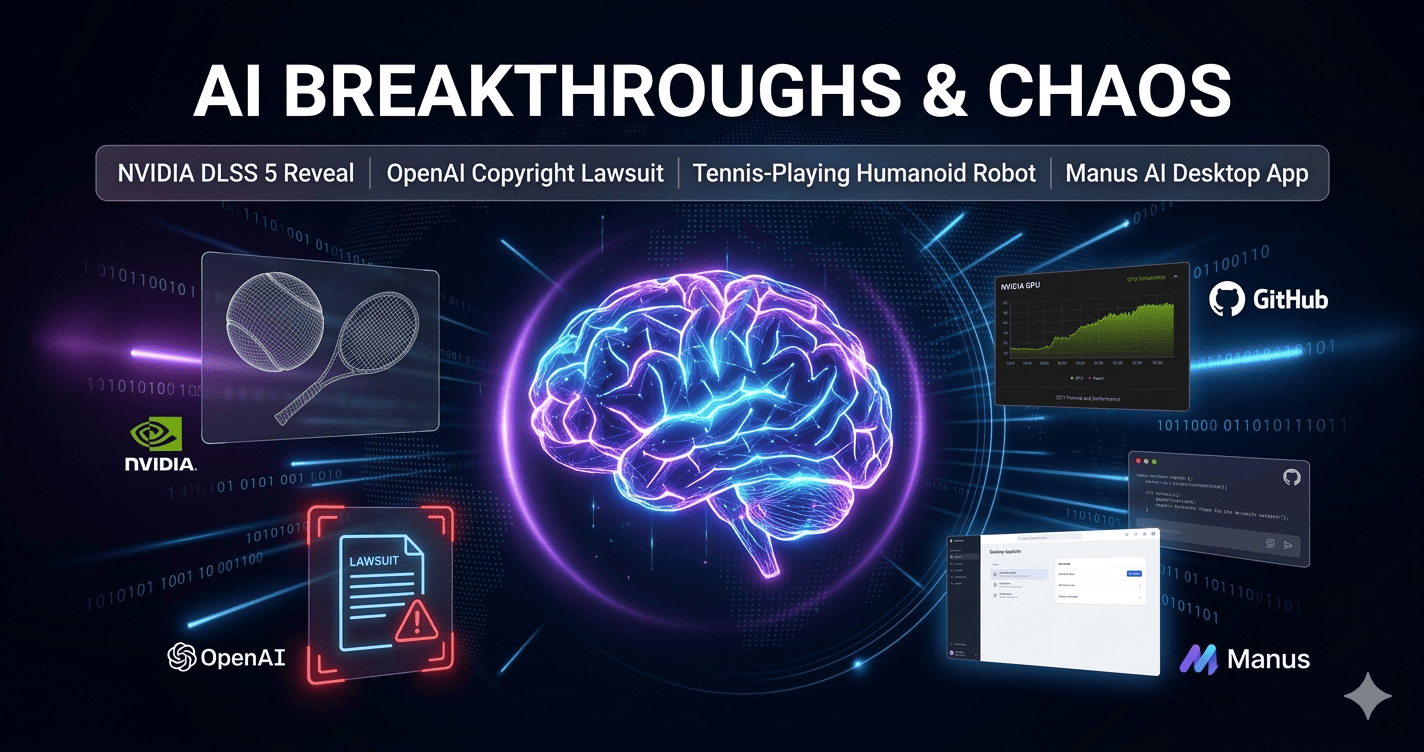
NVIDIA officially announced DLSS 5, a groundbreaking neural rendering model, at their recent GTC conference. This new technology promises to deliver unprecedented levels of photorealistic visual fidelity in video games, significantly enhancing the gaming experience. DLSS 5 leverages advanced AI to render graphics, making games look more lifelike than ever before.
Read full story2. Manus Unveils New "My Computer" Desktop App
Manus has officially launched its new "My Computer" desktop application, which allows its advanced AI agent to directly execute tasks on users' local machines. This innovative app integrates the AI's capabilities seamlessly with personal computer operations, enhancing productivity and enabling more direct control over various functions.
Read full story3. Britannica Sues OpenAI for Copyright Infringement
Encyclopedia Britannica and Merriam-Webster have jointly filed a lawsuit against OpenAI. They allege that OpenAI has committed copyright infringement by using over 100,000 of their articles without permission to train its artificial intelligence models. This legal action highlights growing concerns among content creators about AI's use of copyrighted material.
Read full story4. Researchers Teach Humanoid Robot to Play Tennis
In a groundbreaking development, researchers successfully trained a humanoid robot to play tennis. They achieved this by utilising imperfect human motion data and sophisticated physics simulations. This innovative approach allowed the robot to learn the complex movements and strategies required for the sport, demonstrating significant progress in robotics and artificial intelligence.
Read full story5. Karpathy Reveals How LLMs Work: A Deep Dive
In this insightful video, industry expert Karpathy meticulously breaks down the intricate mechanics of Large Language Models (LLMs). He elaborates on the entire lifecycle of LLMs, starting from the foundational pre-training phase, moving through reinforcement learning, and also addresses the critical challenge of hallucination in these advanced AI systems. This comprehensive explanation provides a clear understanding of how LLMs operate.
Read full story6. Pokémon Go Players Help Train Delivery Robots
Niantic, the company behind the popular augmented reality game Pokémon Go, has utilised data from its players to enhance its visual positioning system. This advanced technology is now being used to train delivery robots, enabling them to navigate more effectively and efficiently. This innovative approach demonstrates how gaming data can contribute to real-world advancements in robotics and logistics.
Read full story7. Poo Bear Challenges AI Clone in Live Songwriting Battle
Grammy-winning songwriter Poo Bear recently participated in a unique live songwriting competition where he faced off against an artificial intelligence (AI) clone of himself. This innovative event showcased a fascinating blend of human creativity and technological advancement in music production, sparking discussions about the future of songwriting.
Read full story8. Pi-Mono: A Tailor-Made Programming Font for Raspberry Pi Terminals
Pi-Mono is an innovative monospaced programming font specifically designed and optimised for seamless integration and superior readability on Raspberry Pi terminals. This font aims to enhance the user experience for developers and enthusiasts working on the Raspberry Pi platform, offering clear and precise character rendering.
Read full story9. GitNexus Unifies Multiple Git Platforms for Easy Repository Management
GitNexus offers a streamlined solution for developers by integrating various Git platforms into one centralised dashboard. This innovative tool simplifies repository management, allowing users to oversee and interact with their codebases from different services like GitHub, GitLab, and Bitbucket through a single, intuitive interface. It aims to boost productivity and reduce the complexity of working across multiple version control systems.
Read full story10. Superpowers Converts Claude Code and Codex into Structured Agents
Superpowers is an innovative system that transforms artificial intelligence models like Claude Code and OpenAI's Codex into structured agents. This technology enhances their capabilities by integrating project memory and defining specific workflows, allowing them to function more autonomously and efficiently in complex coding tasks. The platform aims to streamline development processes and improve AI-assisted programming.
Read full story